

West Sussex boasts a wealth of notable and beautiful churches, often with a hidden story or a fascinating historic connection waiting to be uncovered. Many rural churches bear the architectural stamp of different eras, from Roman foundations to Anglo Saxon arches or Norman towers; Chichester was an important administrative centre for the Normans, and their influence can be seen across the county following William the Conqueror’s advance along the south coast. Each of the churches below has its own individual charm, sometimes in the form of rare 13th century paintings, unusual herringbone stonework or even 120 species of plant in just one churchyard!
Holy Trinity Church, Bosham
Bosham is very much in the spotlight at the moment. It is one of only two English locations named on the Bayeux Tapestry, which is being displayed at the British Museum until July 2027 to mark 1000 years since the birth of William the Conqueror. King Harold II, who is thought to have lived in the village, is depicted seeking a blessing in Bosham Church before sailing to Normandy to meet with William, which precipitated the 1066 conquest.
Bosham is the oldest known place of worship in Sussex and dates back to early Saxon times. It is believed that King Canute was also a resident of the village, back in the day when the picturesque harbour was a thriving port. It is said that his young daughter drowned in the millstream, and a small coffin thought to be hers was discovered in 1865 and can be found just inside the church.
While you’re here: There are many good options to eat in the village from the Anchor Bleu pub or the Shoreside Café, both with a waterside setting, to more refined options such as the Sea School restaurant at the Millstream Hotel.
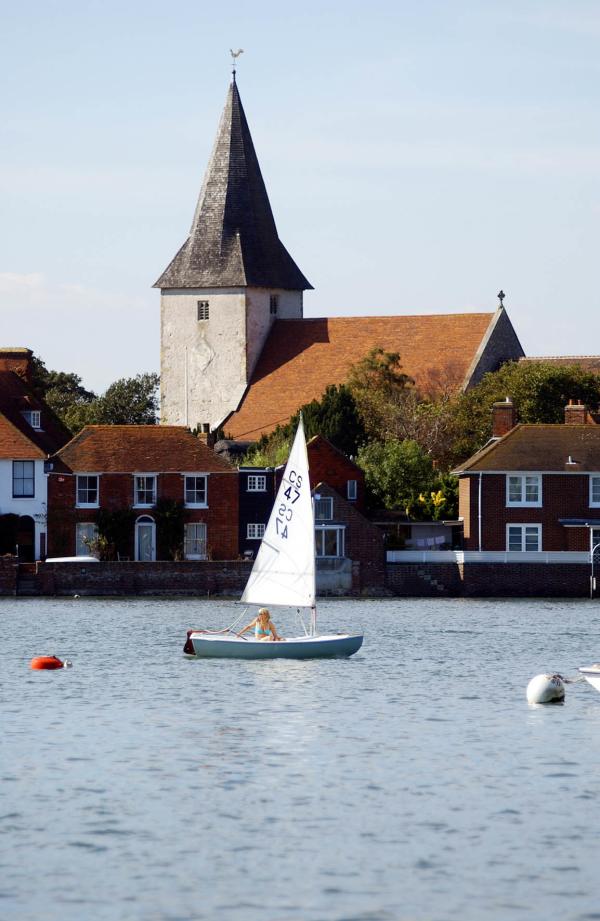
Holy Trinity Church, Bosham
St Boltoph’s Church, Hardham
Thought to have been built in the 11th century, on the eve of the Norman Conquest, St Boltoph’s Church is a quaint whitewashed church just south of Pulborough which remains virtually unchanged over its 1000 years. Inside is a set of paintings depicting many identifiable bible stories for villagers who were unable to read, painted around 1100 by a group of travelling artists. They were hidden for many years under plaster until their chance discovery in 1866. There are 39 murals including frequent appearances by Adam and Eve and St George, many in near-complete form, making this little church an art work of note and well worth a visit.
While you’re here: It is just a short drive to the pretty as a picture town of Petworth where you can be sure to find seasonal and fresh food from The Hungry Guest or E. Street Bar and Grill.
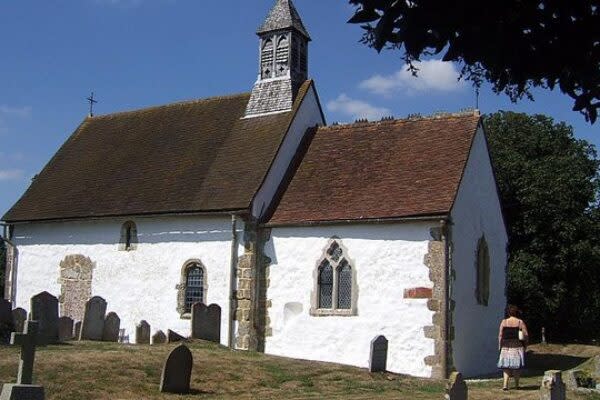
Image: Kevin Gordon - St Botolph's Church, Hardham
Holy Trinity Church, Ebernoe
The much-loved chapel was built in 1867 commissioned by the lord of the manor, W R Peachey, whose initials were carved into the foundation stone at the west end, now rendered illegible. It is tucked away within woodland beside a former school and on the edge of the Ebernoe Common Nature Reserve in the hamlet of Ebernoe, just outside Petworth. There are plenty of paths to wander across this Site of Special Scientific Interest after visiting the well maintained church, and the churchyard is worth taking some time over as it boasts over 120 species of wildlife.
In 1996 Holy Trinity Church made it onto the BBC News and into most of the national press when they were unable to find an organist and purchased a digital hymnal to provide the music. A church warden was invited to give a radio broadcast, such was the interest in this technical development, and afterwards received 40 enquiries from other churches wishing to buy their own!
While you’re here: There are some popular local pubs in which to refuel after a visit. Try the characterful Noah’s Ark Inn in Lurgashall or The Three Horseshoes at Lickfold for a delicious bite to eat.
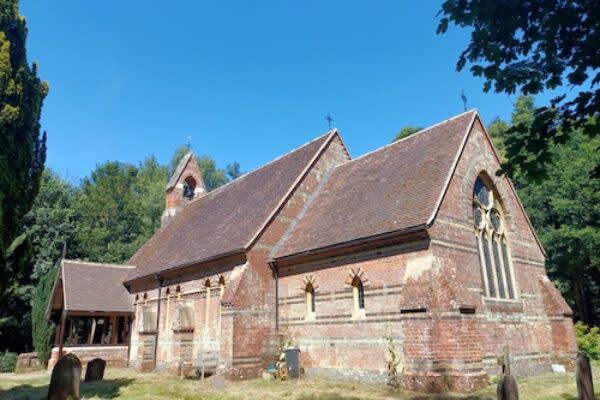
Image: Holy Trinity Church, Ebernoe - Simon Burchell, CC BY-SA 4.0
St Wildfrid’s Church, Church Norton
Located on the edge of RSPB Pagham Harbour Nature Reserve in a pristine and unspoilt setting, the church of St Wilfrid’s gives a fascinating insight into the past. The church is the thirteenth-century chancel of a large Norman church, the main part of the building having been removed in 1864 and rebuilt in the centre of Selsey to serve the expanding population of the seaside resort.
There is a modern stained glass window representing the nature reserve, alongside a monument to John and Agas Lewis from 1537, incorporated into its Norman structure – a wonderful combination of ancient and modern sitting side by side. The church is also the setting for the Rudyard Kipling poem, Eddi’s Service, which tells of the church priest Eddi determined to preach his Midnight Mass one stormy Christmas Eve, despite no parishioners attending save a donkey and a bullock escaping the weather.
Don’t miss: While you are there it is worth exploring Pagham Harbour Nature Reserve, an internationally important wetland site for wildlife in West Sussex, where you will find refreshments, picnic spots, binocular hire and toilets.
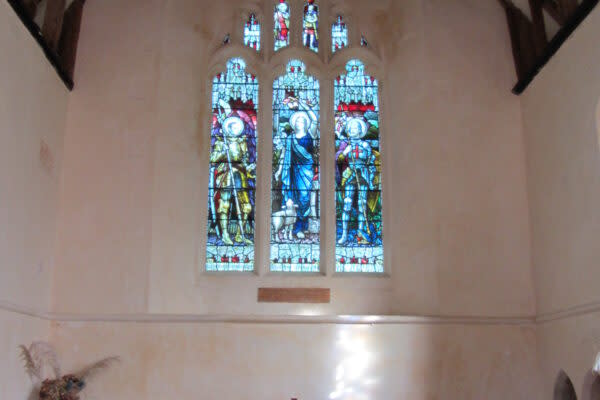
St Wilfrid's Church, Church Norton
St George’s Church, Trotton
A church on this site is listed in the Domesday Book, although the existing church dates back to the early fourteenth-century – all except the font. This church is a rare find in Sussex, having no aisles or a separate chancel, which makes for a fascinating visit. The unusual medieval wall paintings are worth a close look, depicting the Seven Deadly Sins and Seven Acts of Mercy. The church was likely built and decorated at the Camoys family’s instruction (they were the owners of the Manor House across the road), and the church features the oldest known brass of a woman, Margaret de Camois who died in 1310 and whose tomb is in the nave.
Don’t miss: You are not far from Trotton Estate Vineyard where you can book a tour and a tasting. Pop to nearby Midhurst where you will find a warm welcome at the Spread Eagle Hotel or a delicious bite at Cowdray Farm Shop Café.
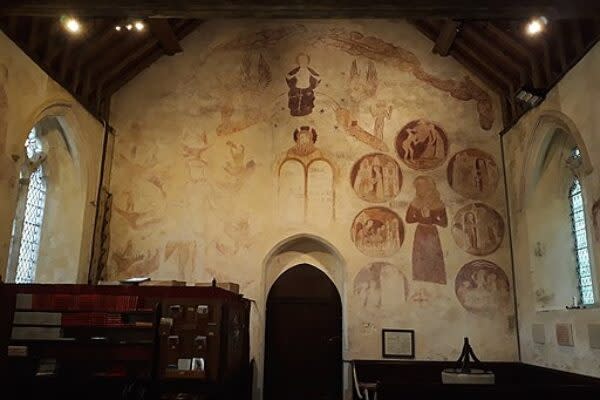
Image: St George's, Trotton, Simon Burchell, CC BY-SA 4.0
St Peter’s Church, Parham
St Peter’s Church set within the grounds of Parham House, is a Grade 1 listed, medieval building in a truly idyllic location. The exact date of its construction isn’t known although its list of rectors fetches back as far as 1148. The oldest part is the vestry built around 1400, although the existing construct is largely Victorian, rebuilt by Cecil Bishop, the 8th Baronet of Parham House. The original village of Parham was destroyed in 1779 because of infection.
The simple interior is filled with beautiful nineteenth-century box pews, including a private pew for the lords of Parham featuring its own fireplace to keep them warm during services. Legend has it that the squire would begin to loudly shovel coal onto the fire to indicate that the sermon was going on too long! The pulpit is of note, adorned with carved plaques made of wood from the Mount of Olives in Jerusalem, from which they were transported by a soldier from the Sussex Yeomanry who served in Palestine during WW1.
While you are here: Don’t skip a trip to the wonderful Parham House and Gardens, where you will discover one of the country’s finest Elizabethan houses. The Mower Shed Café has a delicious range of light lunches and teas if you get peckish.
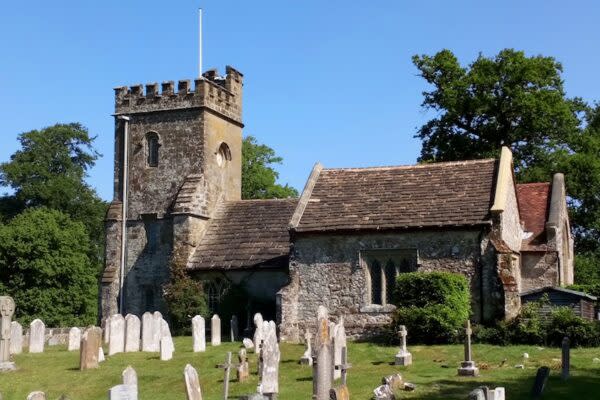
St Peter's Church, Parham
St Peter’s Church, Lynchmere
The church benefits from a stunning setting across the West Sussex valley, and was originally settled by the Anglo-Saxons with a small wooden church. What we see today was probably built around the time of the Norman Conquest with fine examples of Saxon craftsmanship within. The church offers a fine 13th century frieze depicting the seven deadly sins and there is a carved lamb by the font, in memory of a real lamb who sheltered in the church during a storm.
St Peters has been extended over the years, first by the Normans (the tower base is Norman) and then by Augustinian monks from Shulbrede Priory down the hill in the 13th and 14th centuries. Sir Hubert Parry, composer of ‘Jerusalem’ was a part time resident at Shulbrede Priory, home of his daughter Dorothea, and Richard Dimbleby, who lived in the village, is buried in the churchyard.
While you’re here: If you are looking for somewhere to eat, the Mill Tavern in Shottermill does great pub food, or check out The Red Lion, found in the quintessentially English village of Fernhurst.
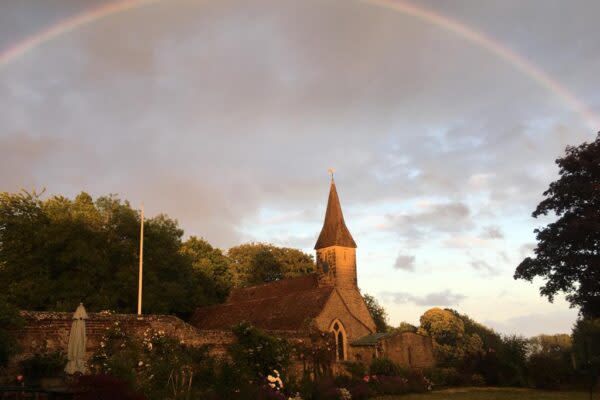
Image: St Peters, Lynchmere by Sanda Belcher
St James’ Church, Selham
This is as picturesque a setting as you could wish for, next to the River Rother between Midhurst and Petworth. St James’ is a church that reflects the variety of construction techniques used over history, and the date is not entirely clear although it is thought to be circa 11th century: a long stone may be a re-used artefact of Roman origin, the nave and chancel of the church have been built in a herringbone stone pattern, typical of the Saxon period, and the beautiful carved arch, south chapel and windows were added later. There is plenty to analyse and speculate upon for those with historical interests.
While you’re here: If you need to refuel after all that history, the Three Moles Pub is just a one minute walk from the church. Or seek out more historical inspiration (and good food) at the Spread Eagle Hotel in Midhurst.
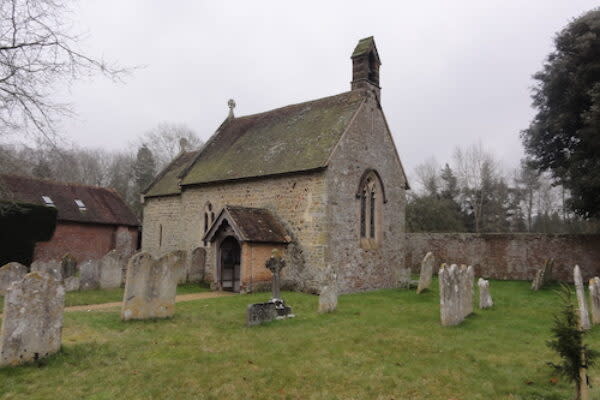
St James' Church, Selham
St Mary the Virgin Church, North Stoke
This quaint church has long been a place for pilgrims to visit, and was once a stop on the old pilgrimage route from Southampton to Canterbury for those travelling to Thomas Becket’s shrine. The name of the church was unknown for many years, until the lost dedication to St Mary the Virgin was discovered in a letter dating from 1275, from a bishop to King Edward I, found in the National Archive at Kew.
There was a church on the site at the time of the Domesday Book of 1086, although it is thought the present church dates from around 1180. Originally just a single cell building, the chancel was added in the 13thcentury and the transepts in the 14th century, with wall paintings far more colourful than was typical of the era.
Don’t miss the captivating early medieval stained glass panels and the magnificent alter frontal designed and made by Belinda Scarlett who has also crafted frontals for Westminster Abbey, York Minster and Winchester Cathedral.
While you are here: You are not far from Amberley Castle and the Amberley Museum, where you can find good sustenance and even more history.
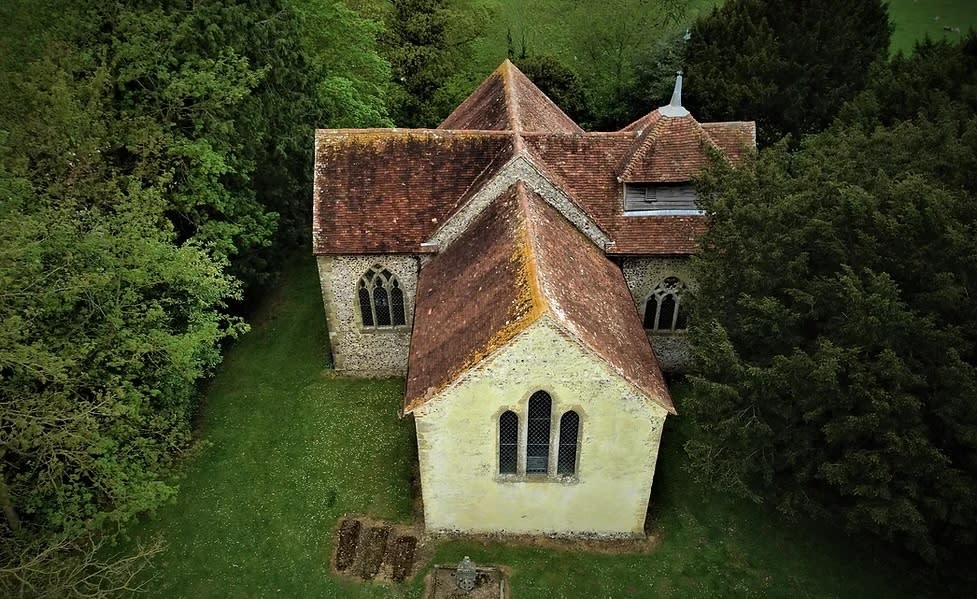
St Mary the Virgin Church, North Stoke
St Michael’s Church, Up Marden
This pretty church, very little changed over a thousand years, is not an easy find being located along a small lane, above a steep slope with just a track through the trees to guide you there – satnav will get you close by if you use PO18 9JR.
It is thought that a community must once have lived nearby to warrant the size of the church when it was built (likely late 12th century or early 13th century), although there is no sign of any remains in the vicinity. The church maintains a whitewashed simplicity and sense of piety, perhaps owing in part to its whitewashed roof and isolated position. In 1994 some rare 15th century paintings were uncovered, the clearest image thought to be that of St Christopher.
While you are here: You are not far from West Dean House and Gardens, where you can eat in the restaurant and admire the Edwardian pergola, Victorian glass houses and walled kitchen garden.
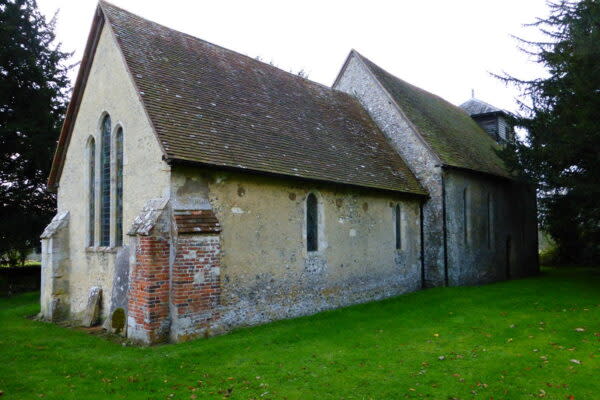
St Michael's Church, Up Marden, by Shazz
Whether you're planning a countryside drive, exploring the South Downs or simply searching for peaceful historic places to visit, these rural churches in West Sussex offer centuries of history, remarkable architecture and beautiful settings. From Saxon foundations to medieval murals, each church tells a unique story that makes it worth the journey.